
The cost of higher education can add up quickly, but there are tax benefits available that may help offset some of those expenses. Two of the most common are the American Opportunity Tax Credit (AOTC) and the Lifetime Learning Credit (LLC).
While both can help reduce the cost of education, they work differently. Understanding those differences can help you determine which credit may provide the greatest benefit for your situation.
American Opportunity Tax Credit
The American Opportunity Tax Credit is generally designed for students pursuing a degree or other recognized education credential during their first four years of higher education.
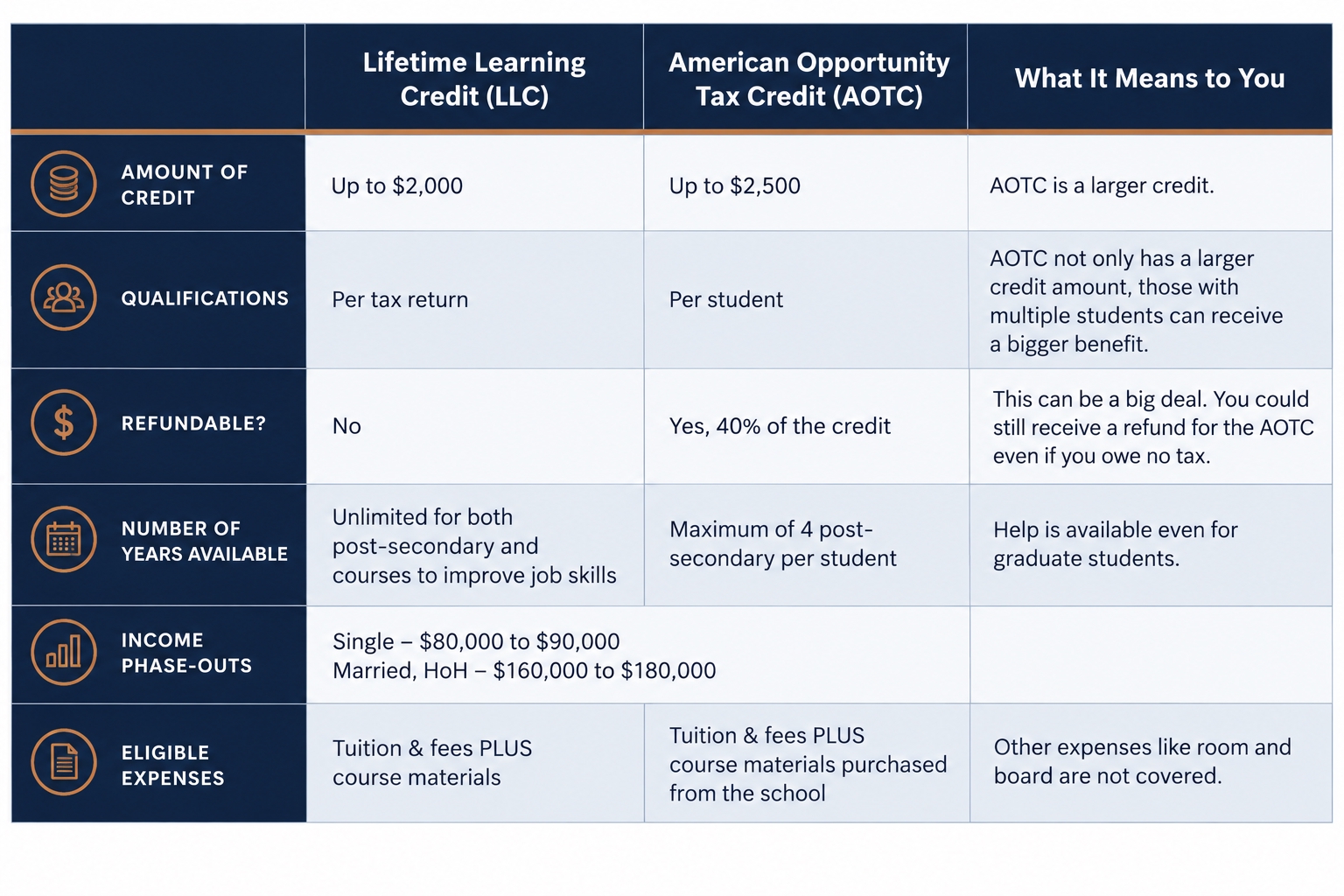
The AOTC can provide a credit of up to $2,500 per eligible student. Unlike many tax credits, a portion of the AOTC may also be refundable, meaning eligible taxpayers could potentially receive part of the credit even if they do not owe federal income tax.
Because the credit is calculated on a per student basis, families with more than one eligible student may be able to claim the credit for each qualifying student.
Lifetime Learning Credit
The Lifetime Learning Credit provides greater flexibility and is not limited to the first four years of college. It may apply to undergraduate and graduate education as well as eligible courses taken to acquire or improve job skills.
The LLC can provide a credit of up to $2,000 per tax return, rather than per student. There is also no limit on the number of years the credit can potentially be claimed.
This can make the LLC particularly useful for graduate students, continuing education, professional development, or students who have already exhausted their eligibility for the AOTC.
Important Differences to Consider
Choosing between the two credits is not always as simple as selecting the one with the larger maximum benefit.
Per student vs. per return. The AOTC is calculated for each eligible student, while the maximum Lifetime Learning Credit applies to the entire tax return.
Limited vs. ongoing eligibility. The AOTC is generally limited to four tax years for each eligible student. The LLC does not have the same lifetime limit.
Different education requirements. The AOTC generally applies to students pursuing a degree or recognized credential, while the LLC can cover a broader range of qualifying education.
Refundability. A portion of the AOTC may be refundable. The Lifetime Learning Credit is nonrefundable.
Coordinating Education Expenses Is Important
Education tax planning can become more complicated when scholarships, grants, 529 plan distributions, employer assistance, or other education benefits are involved.
The same qualified education expense generally cannot be used to receive multiple tax benefits. For example, expenses used to support one education credit cannot simply be reused to qualify for another.
You may be able to use the AOTC for one eligible student and the LLC for another in the same year, but you cannot claim both credits for the same student during the same tax year.
That makes coordinating your education expenses especially important. How tuition, scholarships, 529 distributions, and other education costs are allocated can affect the tax benefit available to you.
Which Education Credit Makes the Most Sense?
There is no single answer that works for every taxpayer. The best approach can depend on the student’s education level, qualified expenses, other financial assistance, income, and the education credits claimed in previous years.
It is also worth reviewing your options each year rather than assuming the credit you claimed previously will continue to provide the greatest benefit.
Somich & Associates can help you evaluate your education expenses and available tax benefits as part of your overall tax planning strategy. Contact our team to discuss which options may make the most sense for your situation.